
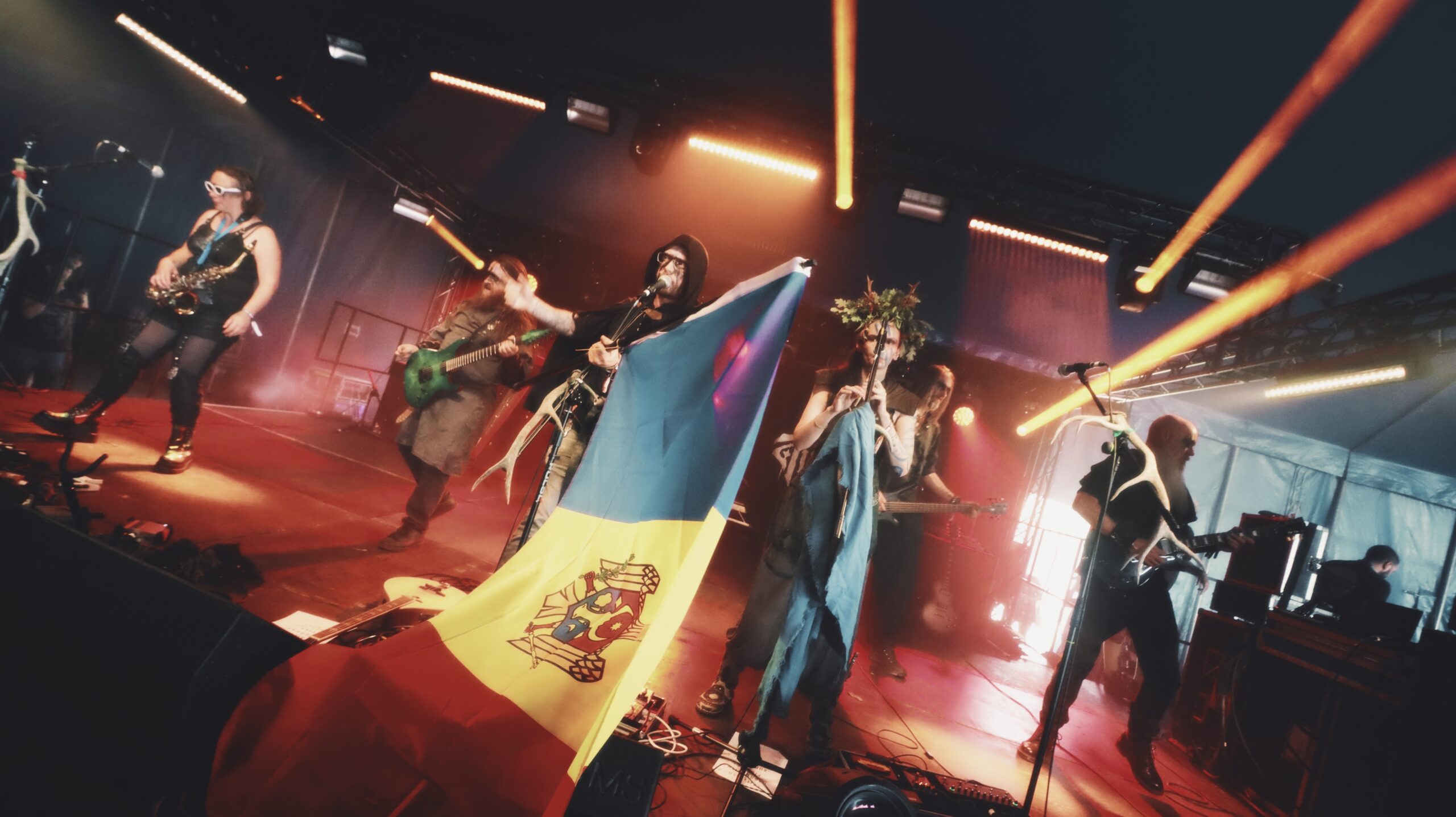
After searching for a quiet corner of Bloodstock (there is no such thing, it turns out) to sit and chat, we end up settling for what can only be described as a tiny glade in the middle of the adjoining forest between the artist area and the arena; incredibly apt for a folk metal band. "It's our first Bloodstock, yeah. We've played at Warhorns before, which is small, independent, predominantly has folk metal, but lots of black metal too," Hazel Mayow, Thunarwülf's whistle player, explains. "It's just a one-day thing," they continue, "we've played that with Sior, which is like Vansinder, who are amazing." Bassist Jesse Armstrong chimes in; "Yeah, Vansinder are really good, aren't they? We're really good mates with them now, and it's really nice that every time I post something about a band I really like, they send me a little card!" It's clear that there's a huge sense of community in the folk metal scene; "Everyone loves each other, and people like you," Armstrong continues. "Yeah, we're all just really into each other's music, aren't we?", quips Mayow.
When asked about the roots of their sound, the band trace their origins back to a shared love of folk traditions and the heavier side of metal. “We were all into folk metal already,” Mayow explains, recalling their own background in the genre as well as their upbringing in a family of folk musicians. Sheffield’s thriving folk scene played its part too, with keytarist Karen O’Donnell already a familiar face in the city’s folk-tronica community. Mayow describes how a casual post in the Folk Metal Grove Facebook group sparked the project, leading them to make the trip from Manchester to join in: “I didn’t really expect any reply, but I gave it a try.” Armstrong points out how the driving rhythms of ceilidh music seemed a natural fit for heavier riffs, while Mayow adds that their ceilidh band already had bass and drums pushing the sound into louder, rockier territory. For Armstrong, the chance to finally embrace folk metal felt like a long-delayed opportunity; “I’ve wanted to do a folk metal band for so many years; finally I found somebody who said ‘let’s do a folk metal band together.'” Andrew Gibson’s story of joining is equally serendipitous, bumping into an old college friend at a Decapitated show just after lockdown. “Not seen you in years… he’s like ‘do you want to start a folk metal band?’ And then he disappeared into the crowd,” he laughs, before summing up that surreal beginning with “And Thunarwülf was born.”
Talking about their individual paths into folk metal, the band reveal a mix of classic gateways and happy accidents. Gibson points to the Scandinavian melodic death metal scene as his first love, with bands like Children of Bodom and Norther shaping his taste, while also crediting folk-tinged acts such as Ensiferum. “My first introduction to folk metal was Finntroll’s “Trollhammaren”, back in the early days of YouTube,” he laughs. “It was silly, but it stuck in my head, and slowly I just found more bands, more gigs, until it became my jam.” Mayow’s route came from a lifetime surrounded by traditional music, blended with a hunger for heaviness; “As a kid, I was always falling in love with the heaviest thing I’d ever heard; at one point that was just a wall of Scottish fiddles. Then I found pop-punk, then britpop’s angrier edges, then death and black metal at uni, and I was like: ‘fucking hell, where did blast beats come from?'” For them, Finntroll’s blend of joy and absurdity proved the point that folk metal could work. Armstong, meanwhile, recalls first bonding with bandmate Gibson over early discoveries like Children of Bodom and Ensiferum, before following the trail on to Turisas and Moonsorrow. “Once you find a few of those bands, you see the same names popping up again and again,” he notes.
When pressed on the one band that really lit the spark for each of them, the answers span generations and genres. Gibson remembers hearing The Smashing Pumpkins and Megadeth blasting from a neighbour’s window as a kid, before bouncing between Savage Garden, Backstreet Boys and Blink-182, then arriving at Avenged Sevenfold and Linkin Park’s ‘Hybrid Theory’, to eventually dive headlong into Scandinavian death metal. Mayow, on the other hand, recalls Dire Straits and the blues at home, then moving on to Green Day, The Offspring and Rage Against the Machine before falling for System of a Down’s ability to weave Armenian folk rhythms into metal – “It proved that everything doesn’t have to be 4/4; it can be more interesting.” For Armstrong, the spark was lit early by an older brother’s Iron Maiden tapes. “I was eight years old at a Christian primary school, singing ‘six, six, six, the number of the beast’ in the playground,” he grins. “The teacher absolutely played hell with me, and I didn’t even know what it meant!” That love never faded, and Armstrong admits he still sneaks as many Maiden-inspired galloping rhythms and dual guitar harmonies into the band’s music as possible. Mayow nods in agreement saying “That influence is clearly there in our sound, those classic metal styles run deep.”