
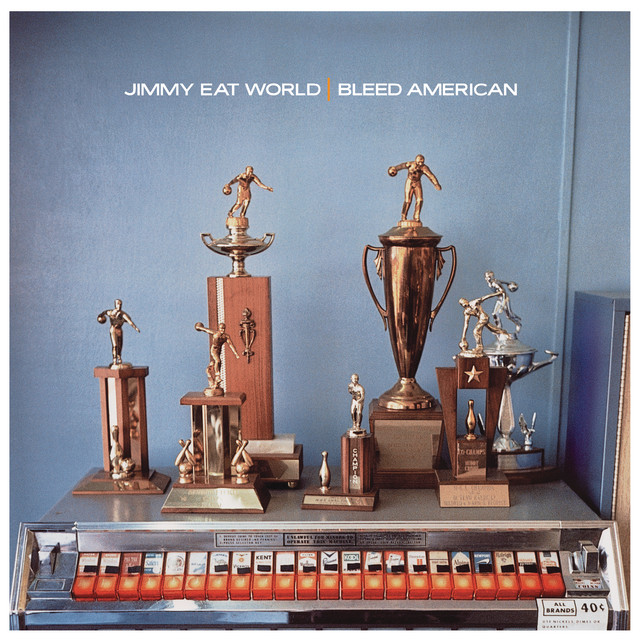
At the turn of the millennium, Jimmy Eat World were finished. Their third album, ‘Clarity’, was a commercial disaster, despite great reviews, and Capitol promptly dropped them in 1999. Through returning to the world of regular jobs, releasing a singles compilation, buying copies of ‘Clarity’ at cost to shift across a five week European tour and deciding they didn’t need to pay for management, the band just about got the cash together for one more album. One more shot at making it work in the music industry. Luckily, they weren’t alone in their faith; producer Mark Trombino offered to work for free as he was convinced their sessions would result in a smash hit. Their friends hired equipment for them. As drummer Zach Lind wrote the final cheque for the mixing, he prayed it wouldn’t bounce.
The result was the platinum-selling ‘Bleed American’, the album which catapulted Jimmy Eat World into the mainstream. Last time anyone checked, it sold close to two million copies and is now recognised as one of the main reasons why emo became the sound of the early noughties. But why? It has to be because of the way that Jimmy Eat World managed to distill the spirit of transience and uncertainty into every note. It’s a record that wobbles on an uneasy footing, switching between reassurance and nervousness, and speaks to any time when the outcome of a choice was absolutely not guaranteed to be good. It’s also a record that creeps into your life at just the right time; for me, it was seven years after its release in the wasteland summer between finishing my education and entering the “Real World”, during which I mooched off friends whose futures were far more secure than my own. It’s the album for trying not to bite your nails when you think about what comes next. Even the titles laden with uncertainty: when I bought a copy, it was just called ‘Jimmy Eat World’. The band were concerned that ‘Bleed American’ would be read as a threatening imperative – “bleed, American!” – after the 9/11 attacks so they quietly removed the title until the album’s reissue.
The ‘Bleed American’ era in Jimmy Eat World history is defined by their status as a singles band, and the string of singles are as good a place to start as any. ‘The Middle’, AKA the song which strained your pinky finger on Guitar Hero World Tour is still a jam, the gentle ‘hey’ offering a mental hug to the girls stuck between a rock and a hard place. The title track evokes a whole scene in just a list of nouns. ‘Sweetness’ – my favourite song on the album, if not my favourite song of the entire Proto-Emo era – sums up that sickening sensation of realising that you just aren’t good enough for the object of your affection, and being forced to pick yourself back up and move on even though you feel like the bottom of someone’s shoe. The tightly-wound ‘A Praise Chorus’ feels like the pep talk you’d give yourself in order to get yourself out of bed in that rejection situation, whether you’re listening to ‘Crimson and Clover, over and over’ or you’re on your feet, on the floor and good to go. Each single captures an entire scene or mood in a few minutes, and that’s what makes them so magical; the sensation crammed into each song will be unique to each listener, but at the same time, universal. For a brief few minutes we’ll all be sharing our own version of the same scenario, soundtracked by Jimmy Eat World.
It’s not just me who saw this record as a friend when we needed one. Paramore and Fall Out Boy have cited ‘Bleed American’ as being influential in their sound. We’d have no ‘Misery Business’ and we wouldn’t be able to ‘Dance Dance’, at least, not in the way we could now. Jimmy Eat World would have been consigned to the list of nostalgic “should’ve been much bigger than they were” bands, and we’d never have ‘Always Be’ or ‘Coffee And Cigarettes’ with their Breakfast Club Coming Of Age magnificence. It was a friend in a cardboard sleeve to so many acts, but most importantly to the band themselves. Jimmy Eat World will be playing a massive park show in London this summer, and if we trace the roots back, that show will come from their determination to create ‘Bleed American’. Everything that we love about Jimmy Eat World in 2026 comes from this album, and a whole lot of our own personal growth too.
KATE ALLVEY